A Tale of Two Doritos Ads: Which ‘Flying Pigs’ Concept Wins?
While the internet debates Doritogate, we tested two ads at the center of the internet phenomenon head to head. Here’s how each creative drove consumer impact.
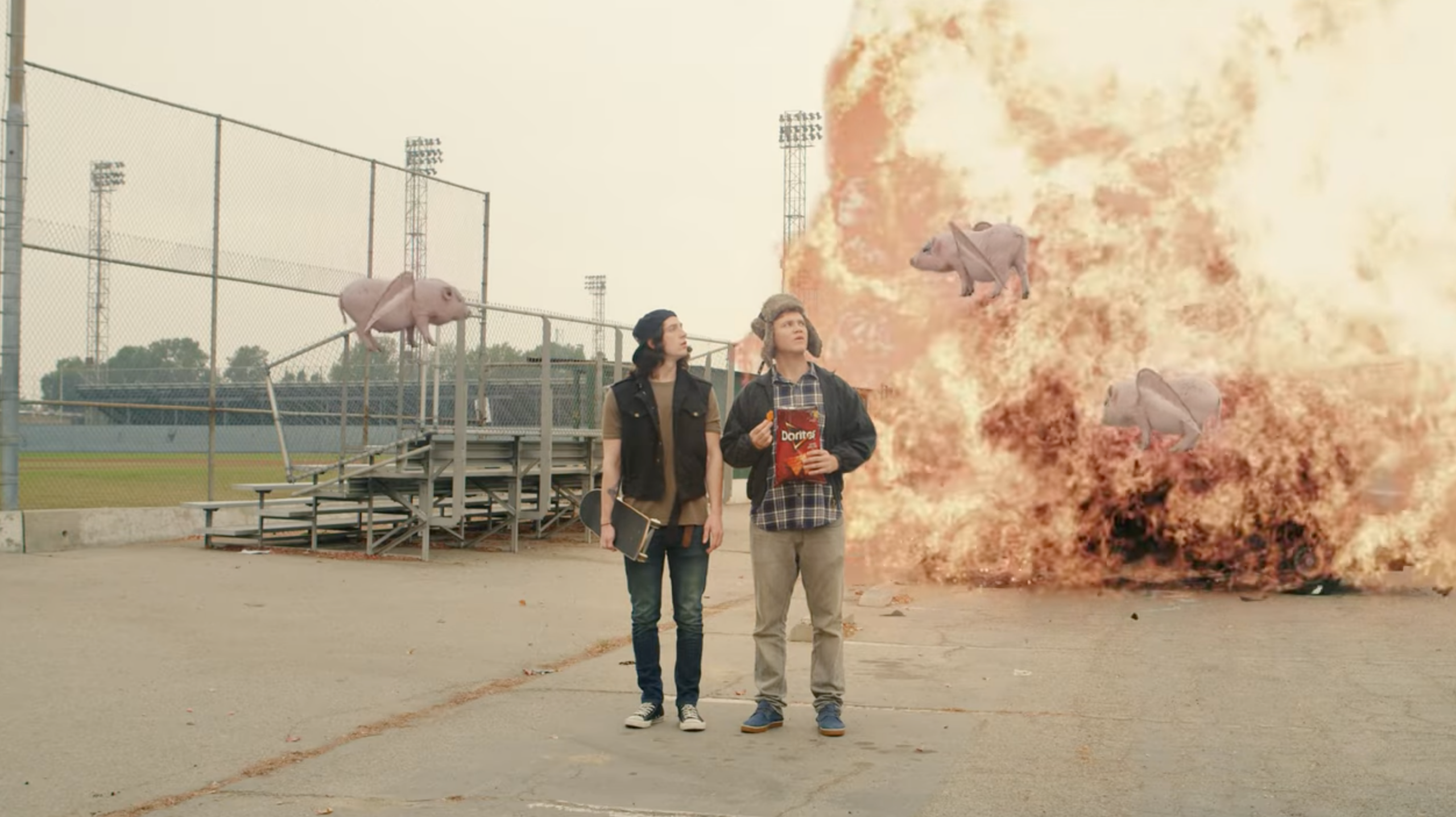
Flying pigs have taken social media by storm—and Doritos is at the center of it.
The phenomenon known as Doritogate has returned to the top of TikTok and Instagram For You Pages thanks to a new development from creator Chris Grieder (also known as Aspiring Alchemist), who brought the story to the internet’s attention earlier this year. Let’s unpack it:
Grieder went viral in early 2026 after sharing an old Doritos commercial he created 12 years ago. The 30-second spot, titled “Yeah Right,” features two friends with a bag of Doritos surrounded by pigs with wings that shoot lasers. He initially submitted that ad for Doritos’ “Crash the Super Bowl” ad contest, and said the ad wasn’t selected and never aired publicly. Check out the original submission:
The internet quickly responded to the ad with what’s now become a new Mandela Effect: tens of thousands of people shared that they remember this ad airing during the Super Bowl, with specific, personal memories and details tied to it.
While views of the unofficial ad skyrocketed across social media after this revelation, it’s important to note that there’s another fan-made Doritos ad that did win the Super Bowl contest, airing during the telecast in 2015—which featured none other than a flying pig. In the ad, a child on a farm sends a pig flying on a rocket after his dad says he can have a chip “when pigs fly.” Shown below, the ad is now gaining traction, with newer comments citing that Grieder’s ad drove them to the video.
The latest development? Grieder recently posted an Instagram Reel (which has since amassed 228,000+ likes) with an update that someone saw the unaired ad screening at a gas pump in Virginia—the only evidence of it ever airing publicly. While the lore of Doritos’ “flying pigs” ads continues to mystify the internet, the viral moment poses larger questions: which ad actually resonates better with consumers, and which one would make them more likely to buy a bag of Doritos at the gas station?
The fan-favorite ad that most people seem to remember but never actually aired? Or the contest-winning commercial that actually aired but people don’t seem to recall as much?
We put the two ads head to head, using Swayable’s rapid randomized controlled trials (RCTs) to test them against nearly 3,700 U.S. consumers. We measured each concept’s impact on brand lift in favorability, consideration, and purchase intent—as well as Super Bowl ad recall. Keep scrolling to find out which ad came out on top.
The official ‘When Pigs Fly’ Super Bowl ad came out on top
Despite the internet’s ongoing Mandela Effect, the commercial that actually aired is the one that moved overall consumers the most. Compared with a placebo group, “When Pigs Fly” drove significant gains in favorability, brand love, and consideration.
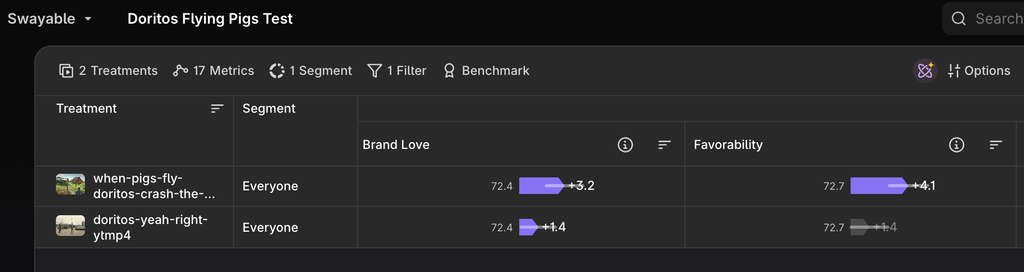
The winning Super Bowl ad drove higher gains in brand love and favorability than the viral counterpart.
“Yeah Right” produced only a small bump in brand love, and its other effects weren’t statistically significant. Head-to-head, “When Pigs Fly” came out ahead on both favorability and consideration.
The gap was prominent further down the funnel. “When Pigs Fly” increased purchase intent and significantly moved 13 of 17 brand metrics, versus just one for “Yeah Right.” For respondents, it also made Doritos feel more fun, authentic and bold, and left viewers happier, more inspired and far less confused.
The Mandela Effect showed up in our data, too. Twenty-nine percent of viewers said they remembered “When Pigs Fly” from a past Super Bowl, but 23% said the same about “Yeah Right,” which never aired at all.
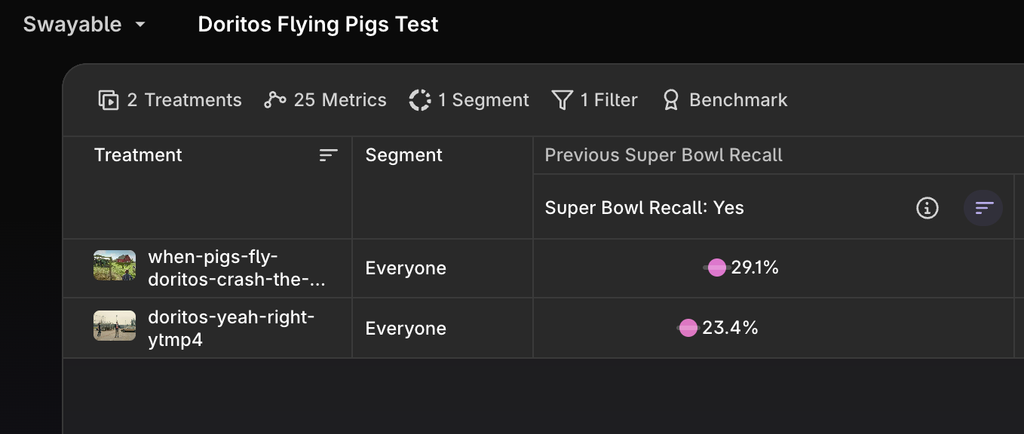
More than a quarter of respondents recalled the two Doritos ads airing during the Super Bowl (even the one that didn’t).
Out West, viral unaired ad finds its audience
There was one part of the U.S. where the fan favorite held its own: the West Coast.
Western viewers who watched “Yeah Right” came away wanting to advocate for the brand. “Yeah Right” even did slightly better at making Western viewers want to recommend Doritos to friends and family.
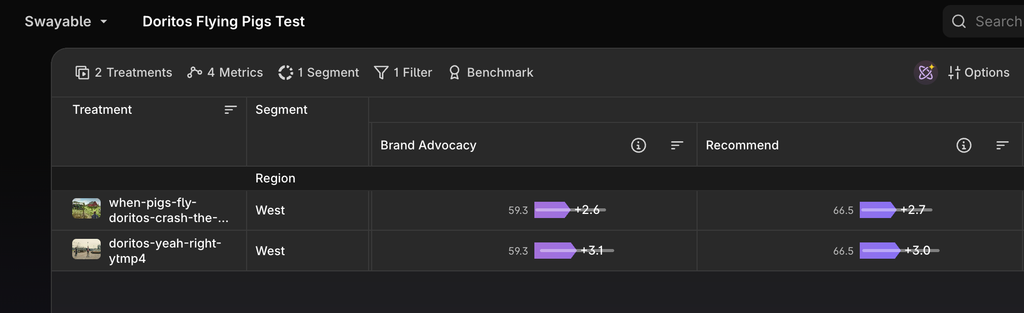
Grider’s ad did outperform in a couple brand lift metrics among West Coast audiences.
What viewers said: a good story beats flashy effects
Both ads made people laugh, but for very different reasons.
“When Pigs Fly” won people over with its story: a clever kid outsmarting a grown-up, a pig on a rocket and a sweet “good boy” ending. Comments included “very heartwarming… not the typical food ad,” with viewers sharing that the ad “actually stuck with me, unlike most snack commercials.” They were also more likely to call it creative and to mention Doritos themselves.
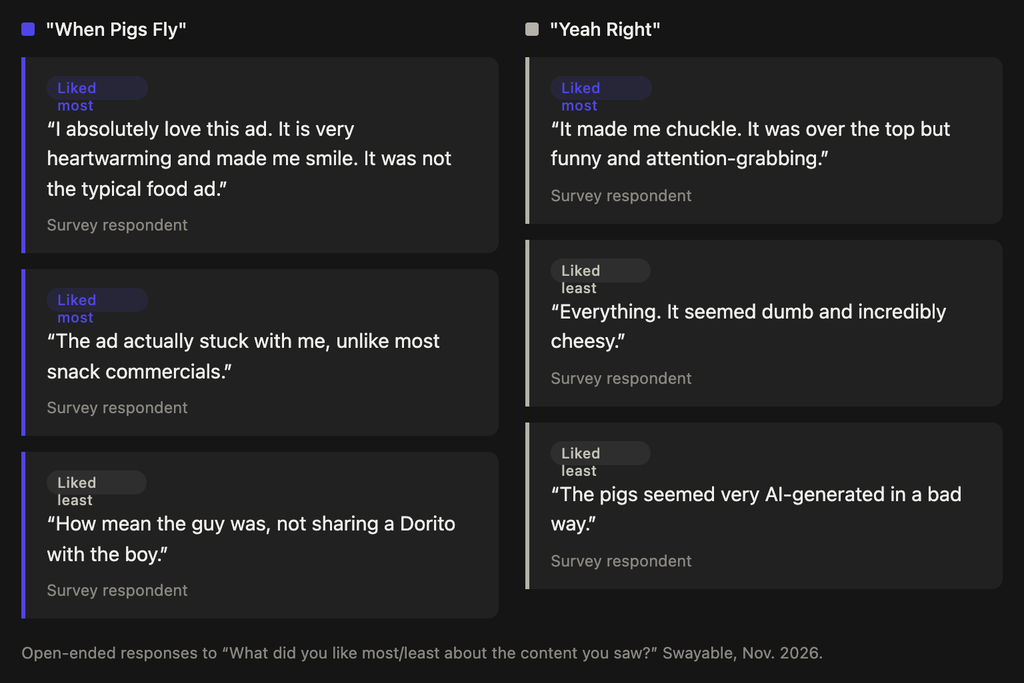
“Yeah Right” leaned on big effects, like pigs shooting lasers and a car blowing up. Respondents either loved it or hated it. Twice as many viewers called it dumb, cheesy or weird, and some even said the pigs looked fake or AI-generated.
“When Pigs Fly” had its critics too, with mostly negative association with the farmer being mean for not sharing his Doritos. Overall, however, the sentiment for the winning ad was that the story made people feel something—and ads that make people feel are more likely to drive positive sentiment for a brand.
The takeaway: The ad people remember isn’t always the ad that works
Doritogate shows how strong (and wrong) our memories can be. Tens of thousands of people are sure they saw a Doritos ad with pigs shooting lasers during the Super Bowl. But the ad that actually aired is the one that, according to Swayable’s results, makes people feel better about the Doritos brand and more likely to buy them.
The ad people remember and the ad that actually drives brand love aren’t always the same. Creative testing can tell you which is which. In this case, the results back up Doritos’ original choice: “When Pigs Fly” was the ideal ad for the brand to run during the Super Bowl.
Methodology
One RCT survey experiment was conducted on Swayable over 48 hours between November 11–13, 2026, with responses from a total of 3,675 U.S. consumers. Respondents were randomly assigned to watch either “When Pigs Fly,” “Yeah Right” or a placebo video, and were then asked a series of questions about Doritos and the content they saw. Questions were asked of a general population sample using Swayable’s proprietary online platform. Responses were screened using industry-standard quality control measures, including checks for attention, speeding, location verification and demographic consistency, along with reCAPTCHA verification. Duplicate respondents are removed based on IP address and device fingerprinting.
The sample frame is U.S. smartphone users across the country with active internet connections who are users of popular mobile and web apps that make up Swayable’s network of respondent partners. Respondents are solicited from partner apps with non-monetary reward offers for their participation. Respondents were recruited with an approximately even ratio of men and women imposed via separate quotas for each. This is a “non-probability sample” (in the conventional terminology of public opinion research, although this team believes this concept is not meaningful since truly random sampling of the population is not possible via any methodology). To correct for over/under-sampling, all samples are post-stratified to the general U.S. population using cross-tabulations accounting for factors including age, ethnicity, gender, educational attainment and geography, based on the latest available data from the U.S. Census Bureau and Swayable’s proprietary population modeling. Margins of error quoted are based on response distribution statistics and sample sizes and are calculated independently for each result. Results are reported as statistically significant at a 90% confidence level unless otherwise noted. Access the survey questions here.
This research was conducted and self-funded by Swayable. Like all public opinion research, this study is subject to unmeasured sources of error that should be considered when interpreting the findings.